Ann Arbor (Informed Comment) – The Israeli newspaper Arab 48 reports that a large anti-conscription demonstration by Ultra-Orthodox (Haredi) Jews in Jerusalem turned deadly Tuesday when demonstrators attacked a passing bus and allegedly threatened the driver, who appears to have tried to get away from them by driving straight ahead. He unfortunately struck 4 of the demonstrators who were in the street in front of the bus, killing one young man who ended up under the bus. The other three were lightly wounded.
An Israeli police statement blamed the demonstrators, saying that they had disturbed the peace, closed off streets, damaged buses, set garbage bins alight, thrown eggs and other things at the police, hurled obscenities repeatedly, and attacked journalists on the scene. The police said that during these disturbances a bus collided with several demonstrators. The bus driver was detained and is being interrogated about the incident. Several journalists were injured by rock throwing and had to be taken to hospital.
Although the bus driver was said to be “from East Jerusalem,” i.e. he was Palestinian, the police do not believe that he was motivated by nationalist considerations. Palestinian and Palestinian-Israeli bus drivers have been attacked on many occasions in recent times, and the driver probably feared for his life if he slowed down or stopped, since the demonstrators might storm the bus and harm him. But forging ahead caused him to run down people ahead of him, who may have been trying to make him stop. That police felt him not to have engaged in a premeditated action is suggested by their arrest and questioning of him. Those Palestinians deemed to be committing terrorism are typically shot on the spot.
“The Haredim have continued protesting against military conscription following the Supreme Court’s decision on 25 June 2024, which required them to serve and barred financial support to religious institutions whose students refuse military service.
The Haredim make up around 13 per cent of Israel’s 10 million population. They reject military service, arguing that their lives are dedicated to studying the Torah, and say joining secular society would threaten their religious identity and the continuity of their community.”
At the rally some Haredi rabbis denounced the Israeli government, calling military service wicked and saying that even the evil gentiles do not force Ultra-Orthodox Jews to serve in their militaries. The rally was organized by committed Haredim such as the 60,000-strong Jerusalem Faction and by the Council of Torah Sages within the Shas Party.
When Israel was established in 1948, the Ultra-Orthodox only made up 2% of the population. They were granted an exemption from military service, to which they objected. Many Haredi men spend their young adulthood in seminary studying the Torah and the Talmud. They are rooted in Eastern European Jewish spiritual currents that are often but not always pacifist, and they do not believe that a Jewish state can be legitimately established by mere human politicians such as David Ben Gurion; rather it must be the work of the Messiah when he comes.
These beliefs clash with those of secular nationalist Zionists, but when they were a small population they were overlooked, rather in the way that the Amish and Mennonites are granted their distinctive styles of life in the US and recognized as conscientious objectors regarding military service. Now, however, they form such a large group in Israeli society that if they won’t serve in the military, it detracts from national security from the point of view of the Zionists. The Ultra-Orthodox have large families and may be an even bigger proportion of Israelis in the future. In any case, the Supreme Court struck down the administrative exemption they had been given.
Many secular Israeli Jews resent the Haredim, since the rest of the Israelis must serve in the military. Secular Israelis have seen their members killed or injured in Gaza or psychologically traumatized by the genocide they committed there (facing high rates of suicide).
Given the Supreme Court ruling that Haredim are subject to conscription just like other Israeli Jews (and the Druze, the only Palestinian-Israelis who serve), the only way for them to avoid military service would be for Parliament, the Knesset, to pass a law specifically exempting them. Such a bill has been proposed, but apparently in its current form it would not restore an absolute exemption.
MEMO reported, “the two parties representing the haredim, Shas (11 seats) and Yahadut HaTorah (7 seats), warned they could bring down the government if the conscription law is not passed.”
These parties form part of the current extreme-right government, which has 68 of 120 seats in Parliament. If Prime Minister Benjamin Netanyahu lost those 18 seats, he would lose his majority, being left with only 50 seats, and the center-right opposition parties could unseat him with a no-confidence vote.
Even the proposed legislation restoring exemption from conscription is not worded in a way that it is acceptable to many Haredim, who are therefore peeved at Shas, which represents Ultra-Orthodox Jews with roots in Middle Eastern countries such as Morocco, and which supports the draft bill. During the rally, anti-Shas posters were pasted all over Jerusalem.
Images of Nicolás Maduro taken into US custody early on 3 January were greeted in some quarters with celebration, in others with criticism, and in many with a familiar sense of déjà vu. They recall earlier moments once framed as turning points: Saddam Hussein pulled from a hole in the ground, Manuel Noriega photographed under arrest, and Salvador Allende, clutching a weapon shortly before his alleged suicide.
Then, as now, the images seemed to promise resolution. Remove the strongman, cut off the head of the snake and a nation’s problems would finally unravel.
That same confidence resurfaced when President Donald Trump suggested that the US would effectively “run” Venezuela following Maduro’s capture, not unlike the post-2003 assumption that Washington could manage Iraq after Saddam’s ouster.
In Iraq, military success was quickly mistaken for political victory. The fall of Baghdad was followed by civil war and an insurgency led in part by Saddam loyalists and Al-Qaeda affiliates, creating the conditions for the rise of ISIS after U.S. forces withdrew.
Supporters of the Venezuelan intervention have pointed to its efficiency – not a single American life was lost. Yet bloodless intervention offers little reassurance that rebuilding a society hollowed out by two decades of authoritarian rule will be any easier. Trump’s promise of a “safe, proper and judicious transition” rings familiar.
From Cold War coups to Iraq, Afghanistan and Syria, regime change has rarely delivered orderly political outcomes. More often, it has laid the groundwork for long-term instability. There is little reason to believe Venezuela will be different.
An old imperial pattern
This instinct to equate the removal of a ruler with the resolution of a society’s problems long predates the US. In 1839, Britain seized the port of Aden in southern Yemen, displacing the local authority of the Lahej Sultanate and imposing an external political order designed to serve imperial interests. The immediate objective of gaining control of a strategic chokepoint was achieved with relative ease.
The long-term consequences were far messier: fragmented governance, weakened local legitimacy and a political landscape shaped by outsiders rather than rooted institutions.
The pattern hardened in the early Cold War. In Egypt in 1952, the CIA backed the Free Officers’ coup against King Farouk I, viewing Britain as an overextended colonial power whose presence was fuelling Arab nationalism and opening the door to Soviet influence.
By overthrowing Farouk, British influence was curtailed and Washington convinced itself it had nudged history in the right direction. What followed instead was decades of entrenched military rule and a political system hollowed of meaningful civilian life.
The 1956 nationalisation of the Suez Canal and the subsequent Suez Crisis, followed by the 1967 war, underscored how regional and international conflicts were inseparable from the instability created by externally influenced regime change. The lesson went unlearned.
A blueprint that backfired
A year later in Iran, the US helped overthrow Mohammad Mossadegh, a democratically elected prime minister who had nationalised the Anglo-Persian Oil Company. Whether Mossadegh in 1953 or Maduro decades later, leaders who sought to wrest control of national resources from foreign corporations faced the wrath of the US.
The short-term payoff came at the cost of long-term legitimacy, paving the way for authoritarian repression by a pro-American shah and, eventually, the 1979 Islamic Revolution.
The same arc would later unfold in Iraq and Afghanistan: initial control, followed by insurgency, radicalisation and collapse. Regime change did not eliminate instability; it postponed it (some would say created it) and allowed grievances to accumulate until they erupted.
Afghanistan stands as perhaps the most comprehensive refutation of the logic of regime change. In 1979, the Soviet Union toppled the existing government and installed a friendly regime, only to trigger a prolonged war that eventually collapsed under its own weight.
Decades later, the US repeated the formula: in 2001, the Taliban were removed swiftly, and a new political order was imposed with foreign backing and vast resources. Yet the outcome was strikingly similar to the Soviet experience: twenty years of conflict, dependence on external support and a rapid collapse once that support was withdrawn.
Two superpowers, opposing ideologies, identical failure. Afghanistan demonstrates that regime change does not fail because of insufficient time or effort; it fails because legitimacy cannot be imported and authority imposed from outside cannot substitute for local political foundations.
Instant coffee, instant democracy?
Closer to home, the US’ record in Latin America offers an unflattering prelude to its later adventures in the Middle East. From Guatemala to Chile, Nicaragua to Panama in 1989, Washington repeatedly engineered swift victories followed by shallow reforms and fragile institutions. Across continents and decades, US-backed regime change has often destroyed what little order existed, leaving behind chaos under the guise of triumph.
Emboldened by Iran, Washington treated Guatemala in 1954 as a low-risk rehearsal. Operation PBSUCCESS removed President Jacobo Árbenz under the assumption that once a troublesome leader who tried to wrest control of the banana industry from the U.S. United Fruit Company (the precursor to Dole Fruit) was gone, and democracy would naturally reassert itself.
Instead, the coup ushered in decades of military dictatorship, civil war and mass repression against the native Mayan population that claimed hundreds of thousands of lives, giving us the term “banana republic.”
A government elected at the ballot box was replaced in the name of freedom, only to extinguish it. Democracy was treated as a deliverable, something that could be installed after the fact, rather than a fragile process requiring legitimacy, institutions and time.
In Panama, US forces removed Manuel Noriega quickly, on the same charges levelled against Maduro: drug trafficking. Yet, the political order remained brittle and dependent on outside support, as well as vulnerable to corruption.
This pattern resurfaced in Iraq in 2003, when Saddam Hussein was toppled with ease, only for institutions to collapse and militias and extremist groups to fill the vacuum.
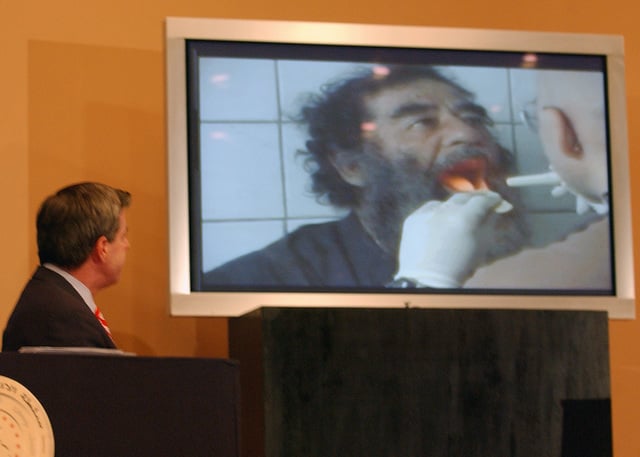
Saddam Hussein Medical Inspection. Scene Camera Operator: SSGT Steven Pearsall, USAF Release Status: Released to Public. Combined Military Service Digital Photographic Files. Public Domain. Via Picryl
“Anyone but the dictator”
The central irony is that removing or weakening a dictator did not produce security or stability. In many areas, it made conditions far worse.
Maduro is in custody and Donald Trump is now in charge. If there is a plan for the days and weeks ahead, it seems to be a closely held secret. It is an understatement to say this is dangerous, if not existential, especially for the people of Venezuela who woke up without lights, without a governing authority and only vague promises of a better life proclaimed from Mar-a-Lago.
A worse-case scenario envisions that banks will not open, ATMs will not work, shops will not accept Venezuelan currency and hard-line security forces and local paramilitaries will brutally insert themselves into the vacuum. If so, expect US boots on the ground to follow.
From Aden to Cairo, Tehran to Kabul, Baghdad to Damascus, and now Caracas, the same enduring fantasy that uprooting a leader is equivalent to creating legitimacy is repeating itself in the vague promises of the US policy for a post-Maduro Venezuela.
When President Trump was asked who would execute the policy of a democratic transition, he made a vague reference to “these guys”. It is certainly the case that these guys have their work cut out for them, and history is not on their side.
Ibrahim al-Marashi is associate professor of Middle East history, visiting faculty at The American College of the Mediterranean, and the Department of International Relations at Central European University. His publications include Iraq’s Armed Forces: An Analytical History (2008), The Modern History of Iraq (2017), and A Concise History of the Middle East (2024).
Tanya Goudsouzian is a Canadian journalist who has covered Afghanistan and the Middle East for over two decades. She has held senior editorial roles at major international media outlets, including serving as Opinion Editor at Al Jazeera English.
( Tomdispatch.com ) – “Quiet, Piggy.” The president was intent on silencing Catherine Lucey. The Bloomberg reporter had provoked him with a question about the release of the Epstein files. His insult caught the public’s attention. But Trump’s tongue-lashing lexicon against women has a long history. Other female journalists have been dubbed “obnoxious,” “terrible,” “third-rate” and “ugly.” Vice President Kamala Harris, opposing him in the 2024 presidential election, was labeled “retarded” and former House Speaker Nancy Pelosi “crazy as a bedbug.” The list goes on (and on and on). And who knows what was redacted from the Epstein files along those very lines?
Mind you, those Trumpian insults hurled at women (and regularly offered about them) are anything but performative throwaways. They reveal Donald Trump’s deep and abiding contempt for females, an attitude that has taken a giant leap forward (or do I mean backward?) in policy terms in the Trump 2.0 years. Well beyond a simple cascade of insulting words, the commander-in-chief and his allies have deemed women the enemy. And not surprisingly, under the circumstances, they are now distinctly under attack.
The Purges
From day one of his second term as president, Trump has made his intention to rid the government of women crystal clear — with some window-dressing exceptions. Without mentioning women per se, he nonetheless targeted them on his very first day in office. Executive Order 14151 vowed to end the “forced illegal and immoral discrimination programs” of the Biden era. (On his first day in office, Biden had issued an executive order opening the door for “underserved communities” via a “whole of government equity agenda.”). Trump’s EO, however, decreed an end to DEI (diversity, equity, and inclusion) and to any appointments that were meant to reflect diversity hiring, claiming that such policies “demonstrated immense public waste and shameful discrimination.”
Immediately, women began to be flung from their government perches. Those holding high positions were the first to go. U.S. Archivist Colleen Shogan was removed, as were the three top women at the National Labor Relations Board. Head of the Federal Trade Commission Rebecca Slaughter was promptly fired, a case still under review by the Supreme Court (though it’s hard to expect good news from SCOTUS these days). The Pentagon cleaned house early and fast, removing women from positions of leadership, including the head of the U.S. Naval Academy in Annapolis; the commandant of the Coast Guard, the chief of naval operations, and the only woman flag officer on NATO’s Military Committee. All had been the first females to occupy those posts. Also sent packing was the woman serving as the senior military assistant to the secretary of defense.
Black women in particular found themselves under attack. Early removals of Black women included Carla Hayden, the librarian of Congress; Gwynne Wilcox, the first Black woman to serve on the National Labor Relations Board; and Lisa Cook, the first Black woman to serve on the board of governors of the Federal Reserve Board. Meanwhile, Peggy Carr, the first Black person and the first woman to be commissioner of the National Center for Education Statistics, was cruelly and unexpectedly escorted out of the building in front of her staff.
The circumstances surrounding the ouster of the first female to lead the National Aeronautics and Space Administration (NASA), acting administrator Janet Petro, highlighted the conviction that emptying offices of women occupants took precedence over quality, efficiency, or overall professionalism. Petro was replaced by an interim appointee, Sean Duffy, who continued to serve in the demanding job of secretary of transportation even as he assumed the leadership of NASA. Better, it seems, to overtax a man than allow a woman to lead anything whatsoever.
The Pentagon
The Pentagon took an early lead in the crusade against women. Even before he was confirmed as secretary of defense (now the Department of War), nominee Pete Hegseth signaled the changes to come under his leadership. Obama’s Secretary of Defense Leon Panetta had opened up combat roles to women in 2015. Hegseth promised to change that. “I’m straight up just saying that we should not have women in combat roles,” he told podcaster Shawn Ryan. “It hasn’t made us more effective, hasn’t made us more lethal, has made fighting more complicated.” The Hillsummed it up well in late July this way: “All women have now been purged from the military’s top jobs, with no female four-star officers on active duty and none in pending appointments for four- or three-star roles.”
Hegseth’s anti-female campaign focused on substance as well as numbers. Women, he suggested, just didn’t have the skills to conduct business with sufficient lethality. According to him, the Pentagon’s Women, Peace and Security program, signed into law during Trump’s first term in office, only served to weaken the Pentagon. Women would merely distract the department from its “core task — FIGHTING,” he tweeted (as Politico reported). Hegseth summarily ended the program. As a U.N. spokeswoman suggested, the removal of women’s voices from the realm of peacekeeping would impede the protection of women and children worldwide.
Healthcare
Back at home, removing protections for females has amounted to a full-scale attack, consistent with warfare, on their bodies. A restructuring of the Department of Health and Human Services has crippled reproductive health programs. In April, HuffPost reported that “the majority” of the Centers for Disease Control and Prevention’s (CDC’s) Division of Reproductive Health was laid off and two of the three main programs of the Maternal and Infant Health division were eradicated. While the Trump administration has consistently tried to hide data about such purges and policies, journalists have kept at it, unearthing some of the facts. Citing “piecemeal and crowd-sourced information,” the Guardian, for example, was able to report that “the entire staff of a gold-standard maternal mortality survey… was also put on leave.”
As it happens, the Republican Congress has joined the assault. Trump’s much-ballyhooed Big Beautiful Bill (BBB), which passed in July, included reductions in funding to Medicaid and the Affordable Care Act, programs that are projected to hit adult women the hardest. Of note, the BBB included a prohibition on federal Medicaid payments to Planned Parenthood. Even before the passage of the bill, the administration had withheld Title X funding from 20 states and 144 Planned Parenthood clinics that, since 1970, had received grants for family planning and reproductive health services. Expectations are that more drastic cuts will follow. In May, the Commonwealth Fund summarized the devastating consequences of the president’s first 100 days in office for women’s reproductive health, detailing a drastic decline in access to medical abortions. And if such reproductive issues weren’t enough to alarm us, the Centers for Disease Control and Prevention (CDC) has removed its recommendation for COVID vaccines for pregnant women and children.
The Record
To add insult to injury, the administration has made it clear that it’s not just women’s positions in government or their healthcare that are subject to eradication. The historical record of women and their accomplishments is also under attack. Across government databases, museum displays, and archival holdings, information about women has been systematically deleted. As I wrote in an earlier TomDispatch post, the erasure of information, historical and statistical, has been a signature weapon of this administration. The websites of the Army and Navy have dutifully removed information about the history of women in the military, while Arlington Cemetery took down its webpage on women buried there, including First Lady Jacqueline Kennedy. And in a similar fashion, NASA opted to remove any mention of women as part of the DEI purge of its website.
The Deception
No essay on the plight of women in the era of Trump 2.0 would be sufficient without commentary on the seeming contradiction between the multipronged attack on women and the presence of women in a striking number of cabinet roles. Seven of Trump’s cabinet appointments are held by women and his chief of staff, Susie Wiles, is the first woman to hold that cabinet-level post.
And yet, that doesn’t seem to have changed the narrative of Trump 2.0 or the impulse to assault women’s rights nationwide. If anything, it has at times enabled it, only further amplifying the administration’s anti-female screed. At the Department of Justice, for instance, Attorney General Pam Bondi, who a decade earlier had voted against the Violence Against Women Act, has reportedly intervened in a number of asylum cases, banning entry to the U.S. for women fleeing domestic violence. At the Department of Homeland Security (DHS), under the directorship of Secretary Kristi Noem, the Office for Civil Rights and Civil Liberties has been shuttered, while “at least 25 sexual abuse complaints” have been dismissed. And when it comes to immigration detention, reports of the sexual and physical abuse of women abound. In the words of Human Rights Watch researcher Clara Long, the conditions are “jaw-dropping.” As Long puts it, “Grievous abuses — assaults, sexual abuse, and discriminatory treatment by U.S. agents — are an open secret within DHS.”
In short, the performances of the women in this administration have undermined the cause of women even more. Chosen for their loyalty to Trump rather than their expertise, their incompetence has been laid out for all to see, scoring high marks when it comes to furthering the perception of women as insufficient to the important tasks at hand. Exhibit One is certainly Lindsey Halligan. A former insurance lawyer who had previously been on Trump’s legal team, she was appointed by Attorney General Pam Bondi to serve as the U.S. Attorney for the Eastern District of Virginia. Halligan subsequently headed up the prosecutions of former FBI Director James Comey and Attorney General of New York Letitia James, who had been at the helm of lawsuits against the president before he entered office a second time. Both of Halligan’s cases were thrown out after a federal judge ruled her appointment to be an unlawful use of the attorney general’s appointment power. The Department of Justice is appealing both cases.
But even before that judge had a chance to issue his ruling, Halligan had harmed the cause of women. Having never led a prosecution before, she faced the grand jury seeking an indictment of Comey without the presence of her own team at the Justice Department to back her up. (After all, her predecessor, Trump-nominated and Trump-fired Erik Siebert had resigned in part because he had determined that there were insufficient grounds for bringing just such a prosecution.) Due to her lack of expertise, she displayed a profound lack of knowledge about trial procedure and courtroom norms. As former prosecutor Elie Honig reported in New York Magazine’s Intelligencer, “the bumbling novice prosecutor” botched many things, including making incorrect statements to the jury and failing to present the final version of the indictment to jury members for their sign-off. Though the case was ultimately thrown out, criticism of Halligan has continued relentlessly.
For those who continue to embrace the exclusion of women from positions of power and consequence, what better proof do they need than Lindsey Halligan — or, for that matter, other women who are being patched into roles they can’t possibly fulfill at a high standard? As French philosopher Simone de Beauvoir long ago commented when it came to women seeking to advance in the world, “Her wings are cut and then she is blamed for not knowing how to fly.”
In sum, women are in trouble in Donald Trump’s second presidency. And yet, there are signs of hope, promising both sustenance and strength for women in the days to come. While the Center for American Women and Politics reports that the number of women in elected office is down overall for 2025, 26 of the 100 senators are now women, the highest percentage ever. (And who knows what the congressional elections in 2026 are likely to bring, given the strong showing of Democrats in elections in 2025?)
Moreover, outside of government, women are far from absent. They currently sit atop the country’s largest philanthropic foundations — Heather Gerken at the Ford Foundation, Amber Miller at the William and Flora Hewlett Foundation, and Louise Richardson at the Carnegie Corporation of New York. They are presidents of some of the country’s most prestigious universities, including Brown, Columbia, New York University, and Yale. At Microsoft, Google, Anthropic, and other tech companies, women are distinctly on the rise, offering expertise, guidance, and leadership, while undoubtedly preparing for a future in which their expertise will be sought.
About-Face?
In recent weeks, inside the Trump administration, there have been signs, however minor, that some of the president’s most devout female allies are starting to dissent. Congressional Representative and Trump loyalist Marjorie Taylor Greene has taken the lead in that female about-face, announcing that she is going to leave Congress before her term is up and going so far as to suggest that she is more in touch with the president’s MAGA base than he is. Like Greene, longtime Trump ally Representative Elise Stefanik has chosen to “call it quits” and leave public office behind. Trump had failed to support her bid to run for governor of New York, just as he had pulled her nomination to the U.N. earlier in the year. And then there’s Chief of Staff Susie Wiles who, however much she subsequently reneged on remarks she made over the course of 11 interviews with Vanity Fair’s Chris Whipple, clearly indicated that she had moved away from the president’s stances on Venezuela, the January 6th pardons, and the Epstein files.
Maybe, just maybe, the undermining of decades of progress stands a chance of reversal.
One of the several citizen science projects I volunteer for is the Seattle Urban Carnivore Project. One of its components is the placement of motion-activated trail cameras in and around the city to gather data about the presence of target species. (Non-carnivorous species are also recorded.) I started volunteering in part to learn how such data collection protocols work; I have cameras on my own land in Thurston County, which have recorded a number of different species, some of them domestic, and including at one point some rather startled late-night hikers.
The team I’m with currently is assigned to a camera is right next to the Green River. As you may have heard (if you’re a PNWer anyway, though I think there was some broader news coverage), we had some flooding here recently. River valleys were especially affected; while some of them do flood regularly, a combination of warmer than usual temperatures and atmospheric rivers flowing in from the Pacific Ocean made for much higher water than we typically see. A few levees, including one along the Green River, were breached.
Flooding doesn’t just displace humans, or just alter human behavior. Accordingly, when my group got ready for our January camera check, we had two major questions: one, would the camera still be functioning, or did the floodwaters reach it and render it inoperable? And two, what interesting or unusual animals might we see, if the camera had survived?
I can’t share any images because of the project specifications, but I can tell you that the camera did survive; judging by the images we retrieved, the water didn’t get quite high enough to flood it. Entirely separate from what showed up on the SD card, though, I took advantage of the large volume of sediment left behind as the floodwaters receded to do some tracking.
“Didn’t there used to be a tree there?” one of the other group members asked, and indeed, there was clear sign of beaver work:
That there should be beavers on the river wasn’t too surprising, but it was the first time I’d seen sign from them at our camera’s location. They did some work on another, larger tree as well:
More exciting was down nearer to the water, which was still running a bit high but much closer to its usual level than in previous weeks. The receding of the flood had left behind smooth washes of sediment on ground previously thick with English ivy: a perfect track trap. While my teammates investigated the camera and filled out the data sheet, I investigated the ground. Top find: otter tracks!
I don’t have photos of them, but there were also raccoon prints, and one very nice coyote track. Most of the tracks were at least a little washed out, which can complicate identification. In the case of these otter tracks, all that’s really clearly visible are the tips of the toes. A few look more like raccoon tracks, and I couldn’t swear to you that they aren’t; they can look similar, and at some point I’ll share about the trail I followed last fall that kept changing species ID until I finally reached a definitive conclusion.
candyheartsex signups close tomorrow! I was going to try to do it this year, but ... I just don't think it's a good idea. I'm starting to really need a break from exchanges, so I'm going to take a couple months off (aside from the ones I already have, which will be over when Festivids wraps up at the end of January) and then show up again when H/C-ex signups open in March.
• PH 9 - Fire Emblem: Soen no Kiseki/Akatsuki no Megami | Fire Emblem Path of Radiance/Radiant Dawn, Honor Harrington Series - David Weber, The Goblin Emperor Series - Katherine Addison
If any of those sound like you might want to write them, the exchange has already had several delays and fingers crossed it'll be able to get them filled and open on time! I know there used to be some Guardian people around here; I don't know if anyone's still actively writing in it, or might be able to advertise the PH in Guardian-centric fandom spaces?
I originally wasn't going to do this one because it got me thinking about Phoebe and I was sad, but then I decided I wanted to talk a little about Phoebe and let myself be sad.
Today in one sentence: Trump is “discussing a range of options” to acquire Greenland, including that “utilizing the U.S. Military is always an option”; Democrats plan to force a Senate vote to reassert Congress’s war powers after Trump renewed claims that the U.S. needs Greenland for national security; Trump said Venezuela will turn over between 30 million and 50 million barrels of oil to the U.S.; on the fifth anniversary of the Jan. 6 attack on the Capitol, Trump warned House Republicans that Democrats would “find a reason to impeach me” if they lose the 2026 midterm elections; and the White House published an official webpage on the events of Jan. 6, that describes the Capitol attack as a “peaceful protest,” and that Democrats and the Capitol Police – not Trump supporters – were responsible for the violence.
1/ Trump is “discussing a range of options” to acquire Greenland, including that “utilizing the U.S. Military is always an option,” framing control of the Arctic island as a U.S. national security priority. Trump claimed that the U.S. “needs Greenland” to counter Russian and Chinese activity, while Denmark and Greenland have said the territory isn’t for sale and that Greenlanders will decide their own future. White House Deputy Chief of Staff Stephen Miller questioned Denmark’s legal right to control the territory and refused to rule out military force, saying “nobody’s going to fight the United States militarily over the future of Greenland.” He added: “We live in a world […] that is governed by strength, that is governed by force, that is governed by power. These are the iron laws of the world since the beginning of time.” Secretary of State Marco Rubio, meanwhile, told lawmakers in a closed briefing that despite Trump’s rhetoric, his goal is to buy Greenland from Denmark and that threats of an imminent invasion are to pressure Denmark into negotiations. (Politico / Wall Street Journal / Bloomberg / Associated Press / New York Times / Axios / Politico / Reuters / ABC News / Wall Street Journal / CNBC / CNN / Politico)
2/ Democrats plan to force a Senate vote to reassert Congress’s war powers after Trump renewed claims that the U.S. needs Greenland for national security. The effort, led by Democratic senators, would use a privileged resolution to require congressional approval before any use of force, framing the move as a check on presidential power after the U.S. military operation that captured Venezuelan leader Nicolás Maduro. Senate Majority Leader John Thune and other Republicans said an attack on Greenland is not seriously being contemplated. (Politico / CNBC / Wall Street Journal / Semafor)
3/ Trump said Venezuela will turn over between 30 million and 50 million barrels of oil to the U.S. Trump said the oil would be sold at market prices and that he would personally control the proceeds, while separately suggesting U.S. taxpayers could reimburse American oil companies for repairing and rebuilding Venezuela’s damaged energy infrastructure. U.S. agencies haven’t confirmed either arrangement, and it remains unclear how the oil transfer, reimbursement plan or broader production push would comply with sanctions law, existing contracts or international norms following the U.S. capture of Nicolás Maduro, who has pleaded not guilty to federal charges. Nevertheless, Trump directed Energy Secretary Chris Wright to execute the transfer immediately using storage ships to deliver the oil to U.S. ports, which described the crude as “high quality” and “sanctioned.” (CNBC / The Guardian / Bloomberg / NBC News / NBC News)
4/ On the fifth anniversary of the Jan. 6 attack on the Capitol, Trump warned House Republicans that Democrats would “find a reason to impeach me” if they lose the 2026 midterm elections. Speaking at a House GOP retreat at the Kennedy Center, he told lawmakers they “got to win the midterms,” framing the vote as protection against a third impeachment after he was impeached twice during his first term and acquitted both times by the Senate. Trump also mused about canceling the elections, saying he would not call to “cancel the election” because “the fake news will say ‘he wants the elections canceled. He’s a dictator.’” (NBC News / New York Times / Daily Beast / Bloomberg / Washington Post / Axios / Reuters)
5/ The White House published an official webpage on the events of Jan. 6, that describes the Capitol attack as a “peaceful protest,” and that Democrats and the Capitol Police – not Trump supporters – were responsible for the violence. The page calls Jan. 6 defendants “patriots” and “hostages,” praised Trump for issuing sweeping pardons, and claims that the 2020 election was stolen even though election officials and courts have found no evidence of widespread fraud. The page also accuses Democrats of fabricating an “insurrection” narrative, and blames the Capitol Police and Mike Pence for certifying the 2020 election results. (Wall Street Journal / NBC News / Axios / Associated Press / Washington Post / New York Times)
✏️ Notables.
Homeland Security began deploying up to about 2,000 federal agents to the Minneapolis–St. Paul area as part of the largest immigration enforcement operation of the Trump administration. The monthlong surge, which started Sunday, combines immigration arrests with investigations into alleged fraud tied to federally funded programs, though the scope, targets, and results of those investigations remain unspecified. (CBS News / Wall Street Journal / New York Times / Associated Press)
The Trump administration said it would freeze about $10 billion in federal funding for child care, cash assistance, and social services in five Democratic-led states. The freeze affects California, Colorado, Illinois, Minnesota and New York, and includes more than $7 billion for the Temporary Assistance for Needy Families program, nearly $2.4 billion for the Child Care and Development Fund, and about $870 million in social services grants. The administration hasn’t provided evidence of widespread fraud outside Minnesota. (Axios / NPR / New York Times / ABC News / Wall Street Journal)
The Corporation for Public Broadcasting’s board voted to dissolve the organization after Congress eliminated its federal funding. CPB leaders said they rejected keeping the nonprofit dormant after losing more than $500 million in annual appropriations, arguing that an unfunded shell could be vulnerable to “political manipulation or misuse.” CPB said it would distribute all remaining funds and close after more than five decades of channeling federal money to PBS and NPR member stations, underwriting national programming, and subsidizing rural and small-market outlets that lacked reliable sources of support. (NBC News / Washington Post / Associated Press / New York Times)
The Wyoming Supreme Court ruled that two state abortion bans, including the nation’s first ban on abortion pills, violated the Wyoming Constitution. The 4–1 decision keeps abortion legal statewide. The justices said the laws conflicted with a 2012 constitutional amendment guaranteeing competent adults the right to make their own health care decisions, rejecting the state’s argument that abortion is not health care. (Associated Press / Mother Jones)
Trump told House Republicans to be “flexible” on a decades-old ban on most federal funding for abortion as a way to secure a health care deal and “own” the issue ahead of the midterm elections. Trump said easing the restriction could help unlock legislation to address rising insurance and prescription drug costs, including a proposal to send health care dollars directly to consumers rather than insurers. Senate Republican leaders and anti-abortion groups, meanwhile, said the Hyde Amendment remains a red line for them and warned that abandoning it could fracture the party. Senate Majority Leader John Thune called the issue “probably the most challenging part” of the negotiations. (Politico / Associated Press / Axios / Politico)
⏭️ Notably Next: The 2026 midterms are in 301 days; the 2028 presidential election is in 1,036 days.
The name yaybahar (pronounced /jajba'har/) has Turkish origin. It is a composite of two words: yay means a "string" or a "coiled string" and bahar means the season "spring." According to Gorkem Sen, the name is derived from the idea of a new life or a new beginning. [1]
I assume this is the third one of its kind the artist has made.
Back at work, but thankfully 1. I don't have to commute, and 2. we are having no-meeting week, so I can just cross one major task off my list every day without adding new things like meeting notes or whatever.
I think the thing I've enjoyed most about the ancillary explosion of joy around Heated Rivalry is the two hockey podcasts that engaged fully and open-heartedly with it (well, and the proliferation of "Ilya gets added to the WAG chat" fic). Normally hockey podcast bros are not a species I have time for (aside from not being good at podcasts or audiobooks in general), but the Empty Netters dudes were super adorable in their reviews, and they also interviewed Ksenia Daniela with great excitement and are scheduled to have Hudson Williams and Connor Storrie on soon.
I also enjoyed What Chaos's less in-depth but still positive look at the show, and they have a couple of interviews with Jacob Tierney available that I haven't watched yet. I was also very pleased when, during a discussion about Shane's ginger ale habit, one of the dudes started talking about a restaurant(?) that lets you choose ginger ale or 7Up for your Shirley Temples, and I was like, "gotta go with ginger ale on that" and then the guy was like, "and the ones with ginger ale are great!" Because that is the legit truth, my friends. I'm not saying I won't drink a Shirley Temple with 7UP, but I am saying that the ones with ginger ale are 1. how we made them when I was a kid, and 2. better. I was reminded of how we ordered one every night at the free cocktail hour on that cruise we went on back in 2015, which definitely made an impression on the staff. *g* (Princess Donut also approves.)
So I feel like those were a great extender of joy, if you are in need. It's really lovely to see some cishet hockey dudes becoming fans of m/m romance.
In other fannish news, I just read that Sebastian Stan may be in Matt Reeve's The Batman, Part 2 and I don't want to get my hopes up or get fixated on a specific part for him to play, but like, wouldn't he be a fantastic Harvey Dent/Two-Face??? GIVE IT TO ME.
Scarlett Johansson has also been rumored to be involved somehow, and she'd have to be like, Poison Ivy, right? Though maybe they're going with more of a Mask of the Phantasm type thing and she'll be Andrea Beaumont? But I am not sure I buy Battinson as having a girlfriend before Selina, and also, why would you try to compete with Mask of the Phantasm? It's so good, you're just setting yourself up for not measuring up. (I guess she could be Talia, but I hope not.)
I guess we'll see what materializes! I'm kind of sad that they are not in continuity with James Gunn's Superman, because that would be fun to see.
No post yesterday because I was in headless chicken mode.
A mercifully aggro-free if late night at Lambert House, both with the trans group and with crunching the numbers. Every once in a while, someone enters the same youth twice, and this causes problems for statistical reporting. B the volunteer manager and I do our best to fix it, but last night things still weren't quite square. Even if I'd wanted to stay until 0200 to fix things as I did in years past with Ken the director looking over my shoulder, that would have been a rotten thing to spring on B. He's responsible for closing up the "house". (Yes, we're still at St. Mark's carriage house, but only until June.)
I'm off call as of this morning. I shall celebrate this evening, one way or another.
Current Mood:relieved
Current Location:the living room of the Devil Girl House
Current Music:the kind of ear worms I get when I need more sleep
When you find there to be a lack of magic in your world, make a new one. That’s exactly what author Nicole Glover set out to do when crafting the whimsical world of her newest novel, The Starseekers. Come along in her Big Idea to see how the ordinary can be made just a little more magical.
NICOLE GLOVER:
I always found it a severe disappointment when I realized as a child that I was living in a world where tea pots weren’t enchanted, ravens didn’t linger on fence posts to give me a quest, and that dragons weren’t snoring away in caves. I didn’t need unicorns or griffins as pets and I never had the urge climb a beanstalk, I just wanted a touch more wonder in the world.
So I did the only thing any reasonable person can do: I started writing fantasy.
From riffs on fairy tales, to tales of travelers seeking a library hidden in a desert oasis, to my current series, in my stories I explored what a world could look like with an abundance of magic.
And with each story I found myself most intrigued by the quieter uses of magic.
The spells in my stories warmed boots, provided a bobbing light for the overeager reader trying to read one last chapter, or put up the groceries for a weary shopper. I found joy in writing about enchantments that made tea kettles bubble with daydreams or devising cocktails that made a drinker recall their greatest regrets. The magic in my stories didn’t include epic quests and battles, and if there were curses, they probably had more in common with jinxes and weren’t nearly as difficult to untangle.
Everyday magic, is the word I like to use for it. Such magic is small spells and charms, that are simple enough for anyone to use and often have many different uses. In contrast to Grand magic which are spells that only a few can ever learn because they are dangerous, and just do one thing really well and nothing else.
Magic that’s in the background, in my opinion, is more useful than Grand spells that could remake the world. (After all what’s the use of a sword that’s only good for slaying the Undead Evil Lord, when the rest of the time it’s just there collecting dust in a corner?) Grand magic is clunky and troublesome, and can be like using a blowtorch when a pair of scissors is all that is needed. You ruin everything and don’t accomplish what you needed to do in the first place. It’s also very straight forward as the magic leaves little wiggle for variation or adjustment without catastrophe. And if a writer isn’t careful, duels involving magic can easily devolve into “wizards flinging balls of magical energy at each other.”
Magics with a smaller scale, leaves room for exploration. It can even allow you to be clever and to think hard of how it animates objects, impacts the environment, creates illusions, or even transforms an unruly apprentice into a fox. Most importantly, Everyday magic are the spells and enchantments that everyone can use, instead of magic being restricted to few learned scholars (or even forbidden).
Everyday magic allows a prankster to have fun, a child could get even on the bully, let’s an overworked city employee easily transform a park, and have new parents be assured their baby in snug in their crib.
It’s also the sort of magic perfect for solving mysteries.
The world of The Starseekers, runs on Everyday magic. I filled the pages with magic that creates staircases out of books, enchant inks and cards, brings unexpected utility to a compass, lends protection spells to bracelets, and even store up several useful spells in parasols. There is an air of whimsy to Everyday magic, giving me flexibility to have it suit my needs. Magic seeps into the surroundings, informing how characters move through the world and how they think about their acts. It allows me to consider the magical solutions to get astronauts to the Moon, how a museum may catalogue their collection of magical artifacts, or what laws on wands and broomsticks might arise and if those laws are just or not.
Embracing Everyday magic is what made The Starseekers possible, because making the everyday extraordinary is one of the many things I aim for as a writer and a lover of magic.
No one really believes Donald Trump is going to last. At the rate he's been declining, it would be a minor medical miracle if he survives to the end of his current term.
tl;dr Who wants to live subject to immoral leaders and exploitive self-sabotaging systems? We are capable of better, and we do have collective powers to choose better and deny support to worse. Let's exercise those powers while we still can avert most of worst.
Once upon a time, the moon Panga was industrial and capitalist and miserable. Then robots suddenly and inexplicably gained self-awareness. They chose to stop working, leave human habitation, and go into the wilderness. The humans not only didn't try to stop them, but this event somehow precipitated a huge political change. Half of Panga was left to the wilderness, and humans developed a kinder, ecologically friendly, sustainable way of life. But the robots were never seen again.
That's all backstory. When the book opens, Sibling Dex, a nonbinary monk, is dissatisfied with their life for reasons unclear to themself. They leave the monastery to become a traveling tea monk, which is a sort of counselor: you tell the monk your troubles, and the monk listens and fixes you a cup of tea. Dex's first day on the job is hilariously disastrous, but they get better and better, until they're very good at it... but still inexplicably dissatisfied. So they venture out into the wilderness, where they meet a robot, Mosscap - the first human-robot meeting in hundreds of years.
I had previously failed to get very far into The Long Way to a Small, Angry Planet, so I was surprised by how much I enjoyed this novella. It's cozy in a good way, with plenty of atmosphere, a world that isn't quite perfect but is definitely one I'd like to live in, and some interesting philosophical exploration. My favorite part was actually Dex's life as a tea monk before they meet Mosscap - it's very relatable if you've ever been a counselor or therapist, from the horrible first day to the pleasure of familiar clients later on. I would absolutely go to a tea monk.
I would have liked Mosscap to be a bit more flawed - it's very lovable and has a lot of interesting things to say, but is pretty much always right. Mosscap is surprised and delighted by humanity, but I'm not sure Dex ever shakes up its worldview in a way it finds true but uncomfortable, which Mosscap repeatedly does to Dex. Maybe in the second novella, A Prayer for the Crown-Shy.
And while I'm on things which are implausibly neat/perfect, this is a puzzling backstory:
1) Robots gain self-awareness and leave.
2) ????
3) PROFIT! Society goes from capitalist hellscape to environmentalist paradise.
Maybe we'll learn more about the ???? later.
But overall, I did quite like the novella. The parts where Dex is a tea monk, with the interactions with their clients and their life in their caravan, are very successfully cozy - an instant comfort read. And I liked the robot society and the religious orders, as well as a lot of the Mosscap/Dex relationship. I'll definitely read the sequel.
Though by now it's mostly dispersed - still lying in parts.
***
Yesterday had that exasperating thing of asking what I thought was a question for very specific thing (not even for myself, for someone who didn't have access to this particular knowledge-resource) and got, okay, one really good response that was right on point, and several which demonstrated that actual humans are quite capable all by themselves of hallucinating what the question actually was and providing answers entirely tangential and Point Thahr Misst.
Pretty much her contemporary, I don't think I ever met the recently-deceased Molly Parkin, but I certainly read various of her writings, including most of her various 'bonk-busters' - I'm not sure they entirely fit that category - which seem to have fallen out of print, at least, they do not seem to have enjoyed e-revival.
I updated my sticky post with: PSA: if you get an email out of the blue that is supposedly from me, offering to help you with marketing or other publisher services, or asking for money, it is not me, it is a scammer. Also, if you see me on Facebook or Threads or XTwitter, that's not me either.
This is a very common scam now, one of the many scams aimed at aspiring and new writers.
One of Wells’ most compelling gifts as a writer is the way she interrogates trauma, and trauma is very much in evidence in her recent works, especially in both Murderbot and The Rising World. Where the Murderbot stories form an enslavement narrative as personal journey and healing, the Rising World series applies a wider cultural lens to trauma and loss.
Kai has seen his world ripped apart twice: the way to the underneath, the world of his birth, is shut off; the world of his above existence, the world of the Saredi, is also gone, both of them murdered by the Hierarchs. (You could argue that the third traumatizing loss-of-world is losing Bashasa, but that lies in the gap between past and present narratives.) In the past narrative, a vanquished Kai himself is imprisoned in the Summer Halls until Bashasa frees him and he joins the ad hoc rebellion.
In 2020, we gave you some insight into our traffic numbers, focusing on the impact that global lockdowns had on our user base. Five years later, we have not only sustained that rise in users but also continued to grow steadily, so we thought we’d show you an update!
Comments in 2025
Image 1: Line graph of monthly comments on AO3 in 2020 versus 2025. Both line graphs share small dips in February, June, and September; and peaks in July, August, and October; before sharply trending upward in December. 2020 sees an additional sharp increase in April, while 2025 shows a more typical slow rise throughout the year.
In our previous post, we observed a common pattern of slight dips in user activity in June and September. This pattern still holds true: Our users left 84,278 fewer comments in June than in May, before coming back en masse in July and August. We see a significant drop in September before cresting a suspiciously Kinktober-shaped peak in October. November sees the bustle die down one more time, before we reach record highs—crossing 5 million comments for the first time—by way of our typical end-of-year holiday increase in December.
Image 2: Line graph showing AO3’s daily page views (in millions) starting in mid-April and ending on December 31st. Smaller spikes show higher activity on weekends than weekdays. There is one big spike to 141 million on June 1st, and two big dips to 73.7 and 72 million respectively on July 3rd and September 29th. The trend line rises slowly but steadily, crossing 110 million daily page views in mid-October.
Site traffic tends to slowly increase throughout the year with a noticeable jump in December, and we then carry that forward into the new year. Our first anomaly happens around June 1st, with several days of incredibly high page views. After consulting with our Systems volunteers, we marked this off as likely being due to a large influx of bot traffic.
On July 3rd and 4th, we ran out of rows in the database table that stores bookmarks, so we had to move them to a larger table that can hold them all! This made it so you can once again add your own bookmarks to the 647 million we already had before then. The recovery after this outage is a little higher than normal, possibly due to an influx of users downloading works to tide themselves over any future outages.
On September 29th, we had to take some planned downtime to implement an update to collections—Collection owners can now use up to ten tags of any type to describe their collection, making it easier to find collections featuring the fandoms, relationships, tropes, and other topics you enjoy.
Image 3: Line graph of daily page views. A subsection of the above graph, more clearly showing the ebb and flow of traffic on the archive throughout the calendar week. There are five clear peaks on every weekend with the apex on Sunday. Thursday and Friday are where traffic dips to its lowest.
If we zoom in a little, we can clearly see that weekends are most of our users’ favourite time to engage with fanworks. Some may wonder about the peaks seeming to run over into Monday—our systems run in UTC and much of our traffic comes from later timezones. More North and South Americans reading late at night on Saturday and Sunday equals peaks on Sunday and Monday!
Image 4: Line graph of requests received by our servers between 9:00 UTC on December 31st 2025 and 9:00 UTC on January 1st 2026. Requests start to rise from ~550K at 12:00 UTC, peaking at nearly 800K at 17:30 UTC before slowly decreasing back down to ~650K. Sharp, sudden drops are noticeable at 16:00 UTC, 23:00 UTC, and 5:00 UTC, with smaller drops at 0:00 UTC and 6:00 UTC.
The delayed effect described in the previous section is especially noticeable on New Year’s Eve. We receive sudden, hourly drops in requests to our servers as users in different timezones pause their reading to ring in the new year. At 16:00 UTC, 47 thousand users in UTC+8 promptly went offline before coming back in force half an hour later, giving us our first noticeable drop. The yearline swept across the globe with minor dips on each hour, before UTC+1 dropped us by a whole 50 thousand requests and UTC followed with just 43 thousand requests. By far the most severe dip occurs when UTC-5 entered 2026, with over 80 thousand fewer requests—compared to UTC-8, which only dropped us by 30 thousand requests.
Image 5: Bar chart showing weekly traffic during the last week of November on AO3 from 2012 to 2025. Large jumps are noticeable between 2019 and 2020, 2022 and 2023, and 2024 and 2025.
To round things off, let’s have a look back through time!
We had a big jump in users this year—November 2025 saw over 146.6 million weekly page views more than the previous November. At first glance this is significantly higher than the 129 million increase we experienced from 2019 to 2020, but this is only 22% growth over the previous year as opposed to 52% because our baseline looks completely different.
We are excited to see where 2026 takes us, and it looks like we’re already starting off strong! In the first week of the year we amassed a record high of 879 million page views, a significant jump up from 816 million the week before and averaging out to ~125 million page views a day. We look forward to breaking more records with you.
The Organization for Transformative Works is the non-profit parent organization of multiple projects including Archive of Our Own, Fanlore, Open Doors, OTW Legal Advocacy, and Transformative Works and Cultures. We are a fan-run, donor-supported organization staffed by volunteers. Find out more about us on our website.
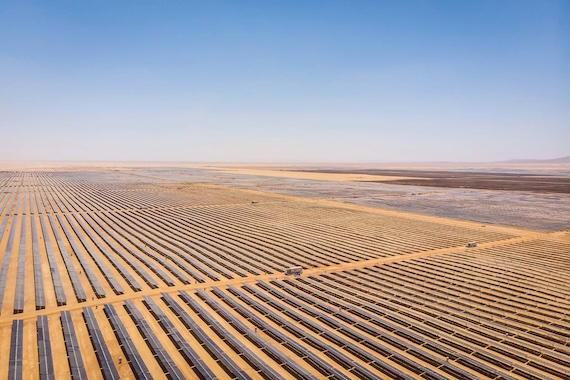
Ann Arbor (Informed Comment) – A new $210 million facility is being built in Egypt to produce 4 gigwatts of solar components annually.
These numbers are not world shaking, but this development is. Egypt has enormous industrial potential. It has as many as 2.5 million workers in various sectors of the textile industry and 33 million over all, and the country’s literacy rate is now on the order of 75%. Literate workers are valuable because they are able to read and follow instructions.
If Egypt becomes a hub for producing solar cells, panels and arrays, it could be an engine for economic growth and also for the production of inexpensive energy in the country, which also acts as a fillip to economic growth.
Green Building Africa reports that “The $210 million Atum Solar project is being developed in the TEDA industrial zone in Sokhna and will have an annual production capacity of 2 GW of solar cells and 2 GW of solar modules.” The investors include JA Solar, a Chinese solar panel manufacturer, as well as concerns in the UAE, Bahrain and Egypt itself. The UAE and Bahrain have substantial investment capital lying about from oil sales, but small domestic populations and lack what economists call absorptive capacity. Egypt is a promising investment field for them as a fellow Arab country with a big workforce.
The plant will create over 800 direct jobs, and likely many more indirect ones.
The solar cells will be exported to the United States. Note that this facility is a way for JA Solar to sidestep the stiff US tariffs on Chinese solar cells, since the units will come from Egypt. The panels will be sold inside Egypt and also to other African countries.
The energy consultancy Ember reported last summer that there are now the first signs of large-scale African adoption of solar panels.
Egypt is, of course, creating large solar farms for electricity generation, and so will have a use for these domestically produced panels. By the start of 2024, the Egyptians had installed 1.8 gigawatts of solar, most of it at the Benban Solar Park some 400 miles south of Cairo in the Aswan Governorate. It now, at the beginning of 2026, has about 2.8 gigawatts of solar capacity, with plans for a rapid build out the rest of this year. Cairo is hoping for 12 gigawatts of sustainables by the end of 2026.
As Chinese labor costs have risen, Chinese companies have been moving to other countries for some manufacturing purposes, benefiting from their cheaper labor costs. It is even government policy, with the slogan “Go out!” attached to it. Since China is the preeminent leader in greentech, it is natural that some of the expansion of Chinese investments in factories abroad would be in sustainables.
One advantage for Chinese firms of investing in a facility abroad is that they can often lower their tariff costs. For instance, the African Union has low tariffs for member states, so a factory that is partially Chinese-owned established in an African country can export cheaply throughout the continent. That role seems to be envisioned for the panels produced at the Atum plant, while the solar cells (the basic component of the panels) will be sent to the US.
If Egyptians manage their affairs well, they could become the Vietnam of the Middle East with regard to solar panel production. Vietnam now produces 18 gigawatts of solar panels annually and is the fourth-largest panel exporter, having 12% of the world market, up from almost nothing a decade ago.
![[personal profile]](https://www.dreamwidth.org/img/silk/identity/user.png)
![[syndicated profile]](https://www.dreamwidth.org/img/silk/identity/feed.png) juancole_feed Jan. 7th, 2026 05:15 am)
juancole_feed Jan. 7th, 2026 05:15 am)